BSS Full-Body™ Wear
This is not basic fitness wear. This is a full-body human stability layer built to watch the body as one connected system, not as isolated parts. The goal is broader awareness, earlier drift detection, stronger context, and a wearable form that can support long-duration monitoring in the real world.

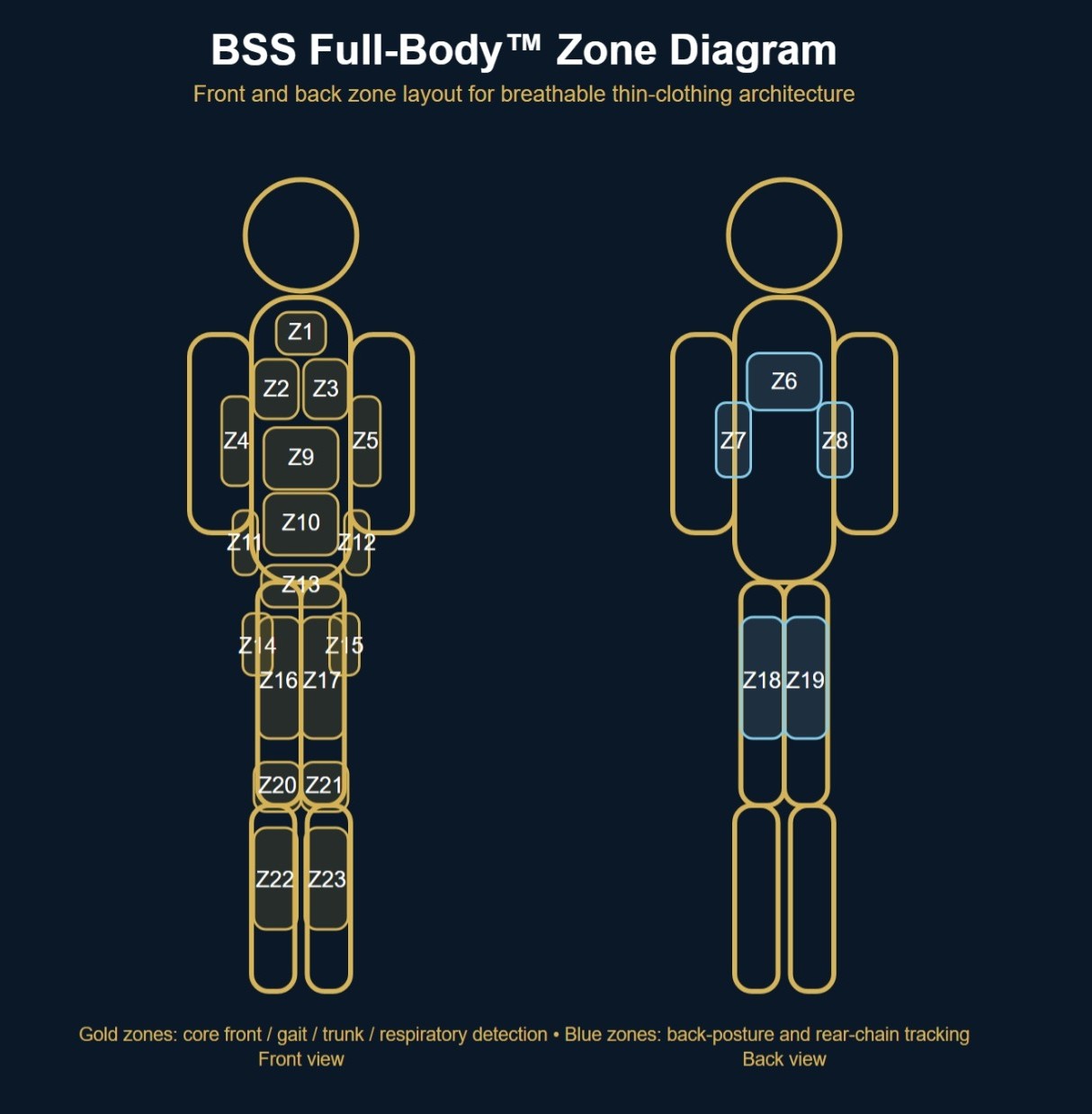
Front and back zone architecture for breathable thin-clothing deployment. Gold zones emphasize core front, trunk, gait, and respiratory coverage. Blue zones emphasize posture and rear-chain tracking.
Total Advantage of the Wear
Why Full-Body Wins
The body does not fail in neat little boxes. Small changes in one region can affect others. A narrow device can miss the chain reaction. Full-body wear changes that by creating a broader sensing map across the trunk, side body, pelvis, thighs, lower legs, and back posture zones.
More Coverage
Instead of only watching one wrist, one chest point, or one patch, this architecture covers a wider body field. That means more useful context and fewer blind spots.
More Relationships
Drift can appear as a relationship between motion, breathing, core stability, posture, and gait. Full-body wear is better positioned to detect those relationships.
More Useful Alerts
Better body context can support stronger early-warning logic, improved trend visibility, and more meaningful decision support than isolated single-point monitoring.
What the Zone Architecture Does
The zone layout is designed to create a practical clothing-based signal map for broad body awareness. Front zones support trunk, respiratory, and movement interpretation. Back zones support posture, rear-chain, and structural drift tracking.
Front-Side Advantage
Front-side zones help monitor body motion, trunk behavior, respiratory activity, pelvic movement, and gait-linked changes. This supports earlier recognition of instability that begins in the body core or movement chain.
Back-Side Advantage
Back zones strengthen posture insight, rear-chain movement tracking, and structural body awareness. This matters because changes in stability often show up in alignment, movement efficiency, and compensatory behavior.
Thin-Clothing Advantage
The goal is to make the system feel more like normal lightweight clothing than a hard device. That improves comfort, helps long-duration wear, and opens the door for practical daily use.
System-Level Advantage
This is not just about collecting data. It is about turning distributed body-zone awareness into human stability insight, drift monitoring, trend logic, and operational decision support.
Where This Wear Has Real Power
BSS Full-Body™ Wear has its strongest value in places where people drift before others notice it clearly. The wear is built for continuous watchfulness, not casual gadget use.
Elder Care
Broader monitoring for posture, gait, movement decline, sleep-related change, and early instability awareness.
Recovery Monitoring
Supports ongoing observation after discharge or during vulnerable recovery periods when subtle deterioration matters.
Occupational and Team Use
Useful where fatigue, instability, or decline can affect safety, readiness, and performance over time.
Home Monitoring
A quieter and more practical monitoring format for continuous daily use in real-world living environments.
Frequently Asked Questions
What makes this different from a normal wearable?
Normal wearables usually watch a limited point on the body. BSS Full-Body™ Wear is built to watch the body as a connected whole through a broader zone map.
Why does clothing-based form matter?
Because real use depends on comfort, coverage, and duration. A breathable thin-clothing format can support longer wear and broader monitoring than rigid single-point hardware.
What is the core strategic advantage?
Earlier, broader, and more useful awareness of body drift. That is the real edge: seeing more of the system before problems become obvious.
BSS Full-Body™ Wear is Built Around One Big Idea
The body should be monitored like a system, not like disconnected fragments. Full-body thin-clothing architecture creates a stronger path toward continuous human stability awareness, better interpretation of emerging drift, and a more practical real-world monitoring format.